


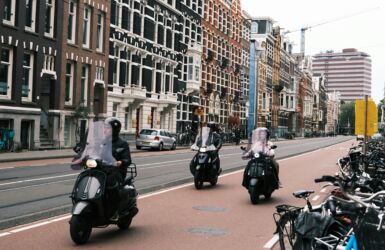
Environmental Zone for Scooters, Mopeds, and Light Motorcycles
Some cities have one or more low-emission zones. A low-emission zone is an area where high-emission vehicles, including older scooters, are not permitted. Whether you are allowed to enter a low-emission zone on your scooter depends on your vehicle’s emission class.
Scooter Low-Emission Zone: Here's How It Works
More and more Dutch cities are implementing low-emission zones to improve air quality. Low-emission zones for high-emission vehicles are mainly found in major cities such as Amsterdam, Utrecht, and The Hague. In these cities, the low-emission zones apply at least to high-emission cars, but the municipalities of Amsterdam and The Hague have also established low-emission zones for scooters, mopeds, and light mopeds.
For scooters, this means that older models with gasoline engines (especially two-stroke engines) are no longer always permitted in certain areas. Municipalities establish these zones to reduce emissions of harmful substances such as particulate matter and nitrogen oxides. Whether you are allowed to enter an environmental zone depends on your scooter’s emission class and the local regulations of the municipality.
Environmental Zone Rules 2026
The rules for low-emission zones vary by municipality, but generally follow the same principle: the more polluting your scooter is, the greater the chance that you will be barred from entering. Many cities consider your scooter’s emission class (Euro standard) and date of first registration (DET). Older scooters—often from before 2011—are no longer allowed to drive within the environmental zone in some cities, while newer models are usually welcome. Checks are often conducted automatically via license plate cameras, and if you violate the rules, you risk a fine. In some cases, you can obtain an exemption, for example for medical reasons or for special vehicles.
Since January 1, 2025, new environmental zone regulations for scooters and mopeds have been in effect in various cities, with rules varying by municipality. For example, in cities such as Amsterdam, new mopeds must be fully emission-free (electric) as of that date in order to be allowed to drive in the city. Existing gasoline-powered scooters are often still allowed to operate temporarily under transitional arrangements, but will be phased out gradually between 2028 and 2030. In addition, several municipalities have introduced zero-emission zones for trucks and delivery vans effective January 1, 2025.
Some cities have plans to expand their low-emission zones in the future, with the goal of allowing only zero-emission scooters to operate within city limits by 2030. Whereas environmental zones initially focused mainly on restricting older scooters, cities are now increasingly working toward completely emission-free city centers. As a result, the rules are becoming stricter, and it’s important to check the specific regulations for your type of scooter in each city.

Environmental Zone for Electric Scooters
Electric scooters are permitted in virtually all cases within low-emission zones. Because they produce no direct emissions, they are considered an environmentally friendly alternative to gasoline-powered scooters. As a result, more and more cities are encouraging the use of electric vehicles, for example through subsidies or designated parking spaces. This makes electric scooters not only more sustainable, but often more practical as well if you regularly ride in urban low-emission zones.
Exemption from the environmental zone
In some cases, it is possible to apply for an exemption from an environmental zone, but the requirements vary by municipality and have become stricter in recent years. Whereas there used to be specific regulations for, say, 4-stroke scooters first registered between 2008 and 2011, these types of transitional arrangements have largely been phased out.
Nowadays, exemptions are generally granted only in exceptional circumstances, such as for medical necessity, commercial use where no viable alternative exists, or for special-purpose vehicles. In some cases, an inspection or additional documentation may be required to support the application. Municipalities assess applications on a case-by-case basis, and exemptions are often temporary and subject to strict conditions. Furthermore, with the introduction of stricter environmental zones and zero-emission areas, the likelihood of obtaining an exemption is steadily decreasing.
Apply for an exemption for medical reasons
Do you own a 2-stroke moped or 2-stroke scooter manufactured in 2010 or earlier? But are you unable to use public transportation, a car, or an electric moped or scooter due to health reasons? If so, you may be eligible for an exemption on medical grounds. To obtain an exemption, you will need to undergo a medical examination by the GGD.
When is a moped or motorcycle an old-timer?
Owners of classic cars are being accommodated. While these vehicles are harmful to the environment, decision-makers felt that banning them outright in Amsterdam would be going too far. You can apply for an exemption for scooters that are 30 years old or older. The exemption applies to weekends and official holidays and is valid for a period of one year. The weekend exemption applies from Friday at noon until Monday at noon.
Even in exceptional cases, exemption is still possible under the hardship clause. Under this clause, an exception to the rules can be made in a law or regulation. This is to prevent certain vehicles from being overlooked.

How old is my scooter?
On the RDW website, you can find out the so-called DET (date of first admission). This date can be found under the heading 'Expiration dates and history'.
How are inspections conducted?
According to the City of Amsterdam’s website, they use both fixed and mobile enforcement tools. This may involve installing cameras that read license plates, but the police can also take action while on patrol. The fine is €90 for scooters, plus administrative fees.
Frequently Asked Questions
How do I know if my scooter is allowed in the environmental zone?
You can check this using your license plate number via the environmental zone check provided by the relevant municipality or on the national government’s website. There you can see whether your scooter meets the requirements. Electric mopeds are permitted everywhere within environmental zones because they do not produce exhaust emissions.
Which scooters are prohibited in the environmental zone?
In most cases, scooters manufactured before 2011 (two-stroke and sometimes four-stroke) are not permitted in low-emission zones. The exact rules vary by city. Different rules may apply in other cities.
Are there any exceptions for older scooters in the environmental zone?
Some municipalities offer exemptions for vintage cars or classic scooters, often based on age or historical use. These exemptions usually require a separate application.
How do I apply for an exemption from the environmental zone for my scooter?
You must apply for an exemption from the municipality where the environmental zone is located. You will often need a DigiD and supporting documents such as your vehicle registration certificate and a statement of the reason for use.
How can I make my scooter compliant with environmental zone regulations?
The only way to allow a polluting scooter into an environmental zone is to replace it or convert it to electric. Subsidy programs are available for switching to electric alternatives.
Never underinsured
Put together your own package
A wide range
We compare all insurers for you, saves time again
Help from our experts
Can't figure it out? Our experts are always ready to help you
We are happy to help you quickly
Can't figure it out online? We're happy to help you via chat or WhatsApp.
 Ask your question and get a response within 2 minutes