


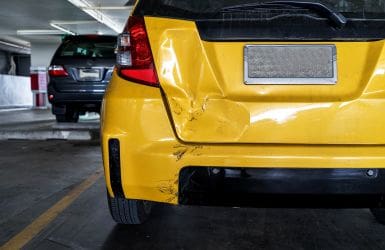
Should I file an insurance claim, or is it better to pay for it myself?
Has your car been damaged? It seems logical to file a claim with your insurance company. However, it isn’t always wise to file a claim. You’ll lose your no-claims years, and your insurance premium will go up. In some cases, it’s therefore more cost-effective to pay for the car damage yourself. When is it best to file a claim for car damage, and when not?

A claim usually costs you your no-claims years
Repair costs can add up quickly when your car is damaged. Even if you accidentally hit a pole while parking, the costs can be high—for example, if the bumper needs to be repaired or if there is serious paint damage.
Damage to your car caused by someone else will be recovered by your insurer from the other party. This will not cost you any no-claims years. However, any claims you file yourself with your auto insurance will count against your no-claims years. If you accidentally collide with another car and are found at fault, the other party’s damages will be claimed through your auto insurance.
Here's how to determine whether you have to pay for the damage yourself
In some cases, it may be better not to file a claim with your auto insurance for minor damage. As mentioned, every claim you file results in the loss of 5 claim-free years, regardless of the amount of the claim. As a result, for minor damage with a low claim amount, it may be more cost-effective to pay for the damage yourself rather than file a claim with your auto insurance.
Often, the premium increase that results from filing a claim is higher than the total amount of a minor claim.
1. You have so many claim-free years that a return to claims will not affect your premium
Have you been driving accident-free for years? If so, you’ve probably accumulated many accident-free years. Filing a claim will cause you to drop down the no-claims discount ladder, but if you’re already at the very top of the ladder, some insurers will keep your discount the same.
2. The repair costs are disproportionate to the premium increase
For minor damage, the cost of the damage isn't always very high. In that case, it's often wiser to pay for the damage yourself. In most cases, the premium increase that results from filing a claim is higher than the repair costs.
3. The repair costs are very high
If the repair costs amount to thousands of euros, it may sometimes be wiser to file a claim with your insurer after all. You can check the no-claims discount scale yourself to see how much more you’ll have to pay in premiums after the claim and compare that to the cost of the repair.

Filing a Claim for Damages When the At-Fault Party Is Unknown
In some cases, there is damage to a car, but the person responsible is unknown. For example, you park your car to run an errand, and when you return, you find a large dent in your door. The person responsible is nowhere to be found and hasn’t left a note. If the person responsible is unknown, you have nowhere to file a claim for the damage.
In situations like this, you can file a claim with the Motor Vehicle Guarantee Fund. Among other things, this fund compensates for auto damage when the at-fault party is unknown. However, it must be determined that the damage was caused by another motor vehicle. In addition, an excess of €250 applies when the at-fault party is unknown.
Auto Insurance Claims and Claim-Free Years
The amount of your auto insurance premium depends heavily on your number of claim-free years. By driving without filing a claim, you accumulate claim-free years. One year of claim-free driving counts as one claim-free year.
Claim-free years entitle you to a premium discount. If you file a claim on your auto insurance, you lose claim-free years. However, this only applies to at-fault claims. If the insurer can recover the paid claim from the other party, this will not affect your claim-free years or the amount of your premium.
In the year you file a claim, you do not earn a claim-free year; instead, you lose 5 claim-free years. As a result, your discount can drop by tens of percent. This depends on your position on the no-claims discount scale. Insurers determine your discount using the no-claims discount scale. Each insurer has its own no-claims discount system, which means there may be differences in discounts among the various insurers.
How Claims Affect Your Premium
The amount by which your premium decreases varies by insurance company. This is because it depends on the discount you receive based on your number of claim-free years. It also makes a big difference whether you have only a few claim-free years or more than 10. To give you an idea, let’s take a random major insurer as an example. For clarity, we’ll leave costs and insurance tax out of the equation.
Sample Calculation
Your car is covered by third-party liability and comprehensive insurance, and you’ve accumulated 7 claim-free years. The insurer gives you a 64% discount on your premium. Based on a base premium of €1,000, you therefore pay €360 in premiums. You cause €650 in damage to the other party’s car. Should you file a claim for this damage, or would it be better to cover the costs yourself?
Because of the damage, your discount rate will drop to 40%. Your premium for the next insurance year will then be €600. This represents an increase of €240. If you look only at next year, it might make sense to file a claim for the car damage. But the consequences go beyond that.
In the following insurance year, you would be entitled to a 72% discount if you had no claims. Because of the claim, the discount in the second year after the accident drops to 48%. You’ll also pay an additional €240 in premiums in the second year. If you look at this over three insurance years, the total premium increase is higher than the amount of the claim. So, when you add it all up, it’s actually disadvantageous in this case to file a claim with the insurer for the car damage. The consequences of filing a car damage claim will be felt for years to come.
Did you also sustain damage to your car in the previous example? If so, the situation is different. Suppose you also had €650 in damage. The total cost of the damage would then be €1,300. In that case, it certainly makes sense to file a claim.
The benefit of a no-claims protection plan
If you opt for a no-claims protection plan when purchasing insurance, you can file one claim per year without it affecting your auto insurance discount. Please note: You will lose your no-claims years. However, this does not affect your premium. Without no-claims protection, you’ll pay more for your auto insurance if you file a claim. When switching to another insurer, you can often transfer your no-claims years.
Frequently Asked Questions About Whether or Not to File a Claim
Is it cheaper to file an insurance claim or to pay for the damage yourself?
It may be better not to file a claim for minor damage, because you lose 5 claim-free years with every claim. For small claims, the premium increase after the claim may be higher than the cost of the damage itself, making it more cost-effective to pay for the damage out of pocket.
How do I file a car damage claim?
Contact your insurer or insurance agent to report the claim. Fill out the European Accident Report Form, which you received when you purchased your auto insurance. Keep this form in your glove compartment so you always have it on hand when you need it. Send the completed form to your insurer to file the claim.
How can I file a claim for damages against the other party?
Fill out the accident report form or use the claims app together with the other party. Draw a sketch of the scene and report the damage to your insurer immediately. With comprehensive insurance, the insurer will cover the damage and seek reimbursement from the other party.
Related pages about auto damage
Never Underinsured
Create Your Own Package
A wide selection
We compare all insurance companies for you, saving you time
Help from our experts
Can't figure it out? Our experts are always ready to help you
We'd be happy to help you right away
Having trouble figuring it out online? We're happy to help you via chat or WhatsApp.
We are open Monday through Friday from 8:00 a.m. to 6:00 p.m.